

 en
en
Choosing an isolator is only one part of developing a compliant aseptic process. The challenge is demonstrating that the equipment, facility, transfers, decontamination process, operating procedures and personnel controls work together to protect the product.
EU GMP Annex 1 places this risk-based approach at the centre of sterile manufacturing. For organisations planning an aseptic isolator project, key design decisions must therefore be connected to the contamination control strategy (CCS) from the outset.
Does Annex 1 require an isolator?
Annex 1 does not state that every aseptic process must use an isolator. It says that Restricted Access Barrier Systems or isolators should be considered within the CCS because they can help maintain the required conditions and minimise contamination associated with direct human intervention. Alternative approaches should be justified.
Installing an isolator does not automatically make a process compliant. Compliance depends on the design, qualification, validation, operation and ongoing control of the complete system.
What should be considered during specification?
The isolator should be specified using a detailed understanding of the complete workflow. This includes:
- How materials enter and leave the system
- Where aseptic connections and manipulations occur
- The number and nature of glove interventions
- Cleaning and bio-decontamination requirements
- Environmental and process monitoring
- Maintenance access
- Routine interventions and foreseeable failures
Annex 1 also requires attention to glove and barrier integrity. Gloves should be visually examined with each use and integrity-tested at defined, risk-based intervals. Isolator leak testing should also be performed at defined intervals.
Poorly positioned equipment, difficult reaches or unnecessary glove manipulations can increase both operational difficulty and contamination risk. Ergonomics should therefore form part of the contamination-control assessment.
What background environment is required?
Annex 1 states that a closed isolator should have a minimum Grade D background, while an open isolator should generally have a minimum Grade C background.
However, these classifications are not automatic. They must be supported by a risk assessment considering the bio-decontamination programme, transfer systems, glove manipulations, level of automation and consequences of a loss of barrier integrity.
Cleaning and bio-decontamination
Bio-decontamination does not replace effective cleaning. Residues can inhibit the decontamination process, so the isolator’s surfaces, layout and installed equipment must allow consistent, validated cleaning.
Annex 1 specifies that an isolator’s internal bio-decontamination process should be automated, validated and controlled within defined cycle parameters using a suitable sporicidal agent. Validation must reflect the configured system, load and intended process.
How can the SKAN pure² support the process?
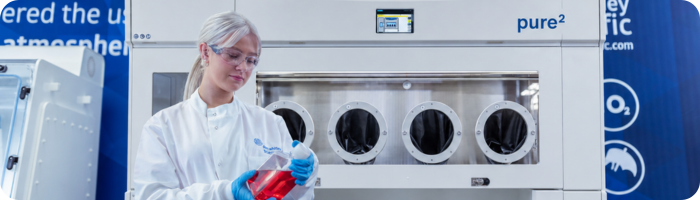
The SKAN pure² laboratory isolator was developed to support aseptic processing in line with EU GMP Annex 1. Its design directly addresses many of the Annex’s expectations for barrier technology, contamination control, cleanability, bio-decontamination and process oversight.
The closed system separates the Grade A working environment from the surrounding room, reducing the exposure of critical processes to personnel and the background environment. Its stainless-steel work areas and material airlocks are hygienically designed to support effective cleaning. The modular design allows chambers, glove ports and airlocks to be configured around the process and transfer strategy.
Each chamber incorporates an automated skanfog® H₂O₂ system designed to provide reproducible, controlled bio-decontamination cycles suitable for process-specific validation. User administration, trend monitoring, batch reporting and audit trails also support the traceability and process control expected within a pharmaceutical quality system.
By addressing key Annex 1 considerations, the SKAN pure² provides a robust foundation for a well-controlled aseptic process. DWS and SKAN work with customers to configure the system around their application and support its integration, qualification and long-term operation.
To discuss your process or isolator requirements, contact Kate George our SKAN specialist: sales@dwscientific.co.uk
Contact form:




 England