

 en
en
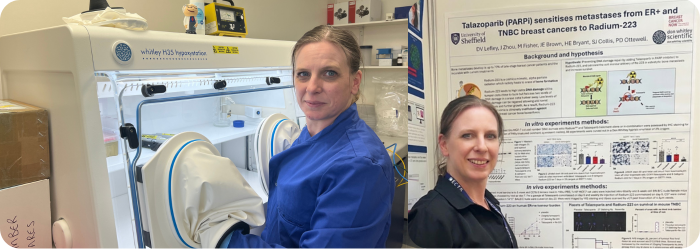
Diane Lefley, a final-year PhD student at the University of Sheffield’s Laboratory for Cancer Metastasis and Dormancy, was recently awarded the DWS Travel Grant to attend The Association for Radiation Research Conference in Cambridge and present her poster on “Talazoparib (PARPi) sensitises metastases from ER+ and TNBC breast cancers to Radium-223”.
We asked Diane to share more about her research:
“My research focuses on a critical challenge: finding better treatments for breast cancer that has spread to the bones.
While a radiation treatment called Radium-223 is successfully used to treat bone metastasis in prostate cancer, it unfortunately doesn’t work on its own for breast cancer patients. My project looks at combining Radium-223 with specialized drugs called DNA damage response inhibitors (specifically Talazoparib, a PARP inhibitor). These drugs block cancer cells from repairing the DNA damage caused by the radiation, potentially making the treatment highly effective for breast cancer patients.
To ensure our lab findings translate accurately to real-life conditions, I use the Whitley H35 Hypoxystation to mimic the low oxygen environment (2-6% oxygen concentration) that tumour cells actually experience in human bone.
I presented my project in a poster titled “Talazoparib (PARPi) sensitises metastases from ER+ and TNBC breast cancers to Radium-223” at The Association for Radiation Research conference at the Moller Institute in Cambridge in June 2026. A massive thank you to Don Whitley Scientific (DWS) for awarding me the travel grant that enabled me to attend, share my work, and connect with fellow researchers in the field!”
Once again, a huge congratulations to Diane on receiving the award and for sharing the fantastic work you and your team are doing at the University of Sheffield. Check your eligibility for the grant by visiting our DWS Travel Grant page.





 England